(Update 2026-04-23 19:19 CET)
Thanks for all the replies. I will shortly update this page, but have to add this after your suggestions and my ideas:
- Why do I call it a “chiptune” station?
- To add: CVGM
- To add: keygen-fm.ru
- To add: www.radio-paralax.de
- Delve into the live-coverage angle of the respective station.
- Ponder if “demoscene” is a better term than “chiptune” for a general purpose station.
There are a number of chiptune radio stations service the demo scene and I have tried to go through the most common ones and try to understand their strengths, weaknesses and general positions. I don’t claim to be an authority on this matter, so if you find anything wrong or disagree with me, please add a comment or send me an email.
I have looked at some of the most well-known stations and compared them, just to get a feeling of the “elbow angle” (that one, important point(-s) of beauty) so to speak. That is the strong points of each station and also where the stations feel lacking.

HYPR Demoscene Radio
hypr.website
The website is modern and responsive and has station just recently arrived on the scene. It has a login feature and easy to see comments. It leverages its playlist so that’s the first thing you see. The clear “in your face”-value of the station is apparent. And it invites you to request tunes. Doing so is clear and easy and the direct approach of the playlist makes it look fresh and updated. Requests are generally directly played with little waiting time. The underlying features are fairly close with few clicks, meaning that the request system is pretty much its selling point. That is more than anything its clear “elbow angle”. Hypr lives for the request feature. It has a pretty comprehensive database of songs and artists with basic facts and also tags for demoparties. There are a few weaknesses and one of it is that it clearly allows you to request up to four songs with the same artist. This is probably not a good thing in my opinion.
Size: 1-4 listeners at the same time.
Brand recognition: Unknown. Probably relatively unknown as of yet.
Song database: unknown, seems pretty large.
Elbow angle: modern site, “challenger station” approach, very capable request system, well-built infographics system with good tagging.
DJs: None.
Pros: modern website, direct approach, strong focus on easy requests.
Cons: no easy way to see what is newly added on the station, request focuses a bit too much on the artists. The songs can be found, but may be a little bit more work.

Slay radio
slay.radio
A staple of the community and has a clear focus on what it’s doing, that is, C64 remixes. Old and respected. It’s probably the one of its kind, as I don’t know of any chiptune station focusing on just remixes. It has a long-standing tradition of live shows, doubling as podcast episodes and a vibrant community on Discord and is linked to the Arok demo party. It also holds a number of competitions for remixers that are also keen listeners. The website is good looking, but badly structured. It holds old news as its primary focus. And playlists and requests are hidden in menus. The request feature is not automatic, but seems to send a mail to the orgas. The website feel stale and hides its features well. The basics like stars, types, comments and other data is fairly easy to spot and makes sure you can see what is playing and interact with it.
Size: 60-90 listeners at the same time.
Brand recognition: strong, well-known and liked
Song database: unknown, seems pretty small.
Elbow angle: strong listenership, community presence, true station audio processing.
DJs: Slaygon and Ziona (live shows only, not on playlist).
Pros: a unique “signal”, strong listening (relative), popular, vibrant community, much activity, podcast like show list.
Cons: stale website, hidden features in menus that no-one can easily find, not easy to use song card functionality.

Nectarine Demo Scene radio / Demovibes
scenestream.net
The grand daddy of it all. That “original gangster” of stations. It’s true legend that seems to always have been there. The website is really badly maintained. It looks horrible on small screens and gives a very stale impression. It’s not directly clear how to begin listening, even though it can be found with a little bit of effort. The site is extremely stale except for the comment section. It has a very well built database with a lot of good information. It seems to build its selectivity on voting patterns. A lot of the songs have fairly low ratings and still seem to be played, meaning the curation of songs may suffer at times. It has data what has just been added and seems to actively add new tracks on a regular basis. No clear sign of any selectivity of newly added tracks. It probably relies on voting to make sure low quality tracks does not get too much airtime. Some artists seem to just send everything they got in large batches. This probably leads to a clear ingress bias of tracks. Not sure this is a disadvantage at all. But it says something.
Size: unknown, probably medium to large.
Brand recognition: unprecedented.
Song database: unknown, probably extremely large
Elbow angle: great library, strong listenership, legendary reputation.
DJs: None.
Pros: extreme brand recognition, long history in the scene, heavy focus on voting to achieve selectivity, clear signs of good activity, old and well positioned.
Cons: very badly maintained website, stale information, unclear where to find all features of the website, old and badly optimized web presence.

Scenesat
scenesat.com
Scenesat is an instrumental part of the demo scene that is the power of most demo scene streaming capabilities. It broadcasts, records and archives all major demo scene events. It’s by and large the work of scener Ziphoid and has a radio station of its own. And also a number of active podcastlike shows that seems to rely on CUE-files of chapters rather than the more common RSS-feeds. The website feels old and is badly maintained. A lot of the features are hidden under menus and can be tricky to see that they even exists. The stream is direct and “in your face”, but just provides basic information. A very primitve webplayer comes with few features. But it has next song, previous song and timing. It’s clear the station is not really the focus of the site.
Size: unknown.
Brand recognition: well-known and respected.
Song database: unknown.
Elbow angle: does important community service for the demo scene, provides a lot of services and is highly respected.
DJs: Subi and Ziphoid (???)
Pros: good brand recognition, has a lot of diverse services for the demo scene
Cons: undermaintained website, little metadata for the station.
Kohina
Kohina.com
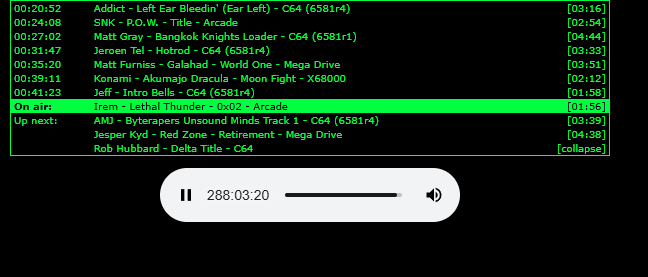
As far as I know, it was founded in the 2000s by a Finnish scener. It once had a forum, but it seems to have disappeared or ceased operating. There is no clear signs of any developement or additions of songs. The minimalist approach and clear “old school computer terminal” approach is appealing and informative. It can both display what is playing, what’s up next and a few of the most recently played tracks. To the best of my understanding, the station has been abandoned and does not have any known future plans. Please correct me, if I’m wrong.
Size: unknown.
Brand recognition: well-known but unclear popularity.
Song database: unknown.
Elbow angle: Tried and true with a striking familiarity.
DJs: None.

CVGM.net
radio.cvgm.net/demovibes/
fvvv
Size: unknown:
Brand recognition:
Song database:
Elbow angle:
Pros:
Cons:
Keygen-FM
keygen-fm.ru
fvvv
Size: unknown:
Brand recognition:
Song database:
Elbow angle:
Pros:
Cons:

Radio Paralax
www.radio-paralax.de
The website sticks out as it is clearly it one of the most informative stations when it comes to news, backgrounds of the team and other information. It also comes with forum that has not been updated since 2014 (!). The news are still updated and the station has recently announced its participation in a demo scene event. The site is modern, works with mobil phones and has a well setup information system. But some of the data is hidden in submenues. It also has far more listeners at the same time than any of the other stations I have gone through except SlayRadio. One problem is that it is in German and the other is that going to the submenues causes the stream to cut out. It also comes with some sort of live shows, but I get the feeling most of them are on hiatus.
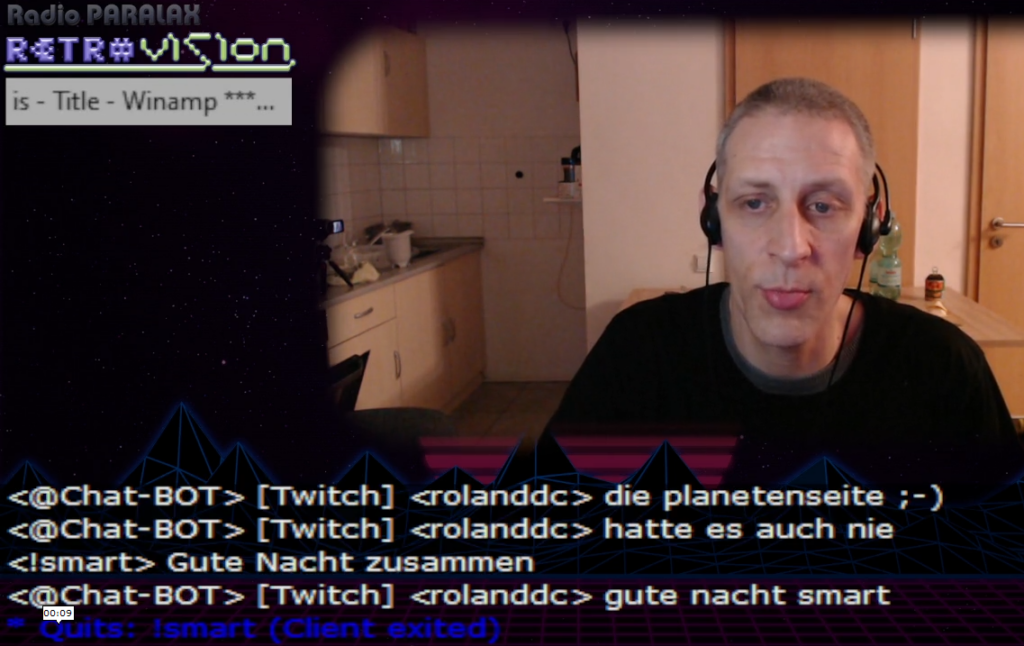
It does have some sort of video streams on a semi-regular basis.
Audio profiling
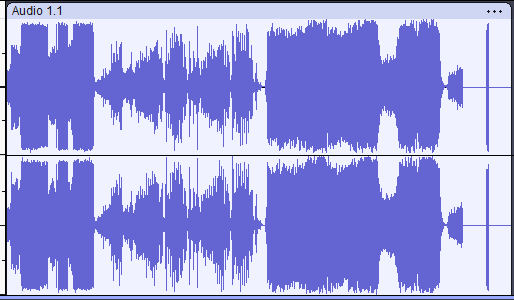
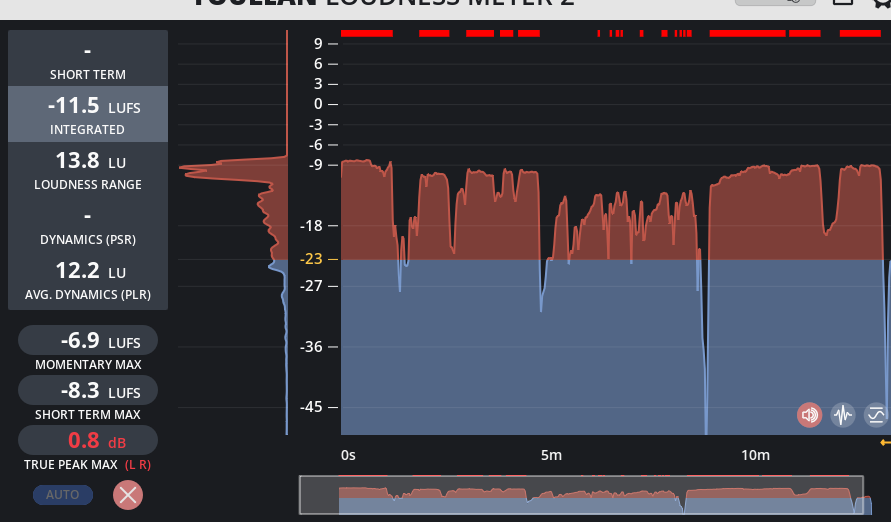
My feeling was that it seemed to be heavily processed, but that turned out to be incorrect. The station seems to be running without any levelling at all. The reason for the heavy dynamic audio compression was the tune that just played. It pushed the integrated LUFS -9 dB LUFS. The next tune was much softer. After listening a while, I understood that it relies on whatever song is playing to control the sound shaping. In reality, this is probably not a problem. But it does mean that every song comes with its own dynamic profile. This means that one song may feel too loud and the next too weak. Modern music is pushed very hard, whereas older tunes may have a much lower levels. I think this is probably just fine as they seem to play mostly remixes.
Size: 40-50 listeners.
Brand recognition: Wellknown.
Song database:
Elbow angle: active in the gaming/streaming community,
DJs: None.
Pros: modern and well-built website, many different streaming formats and bitrates
Cons: player cuts out when navigating the site
ERICADE radio
ericade.radio
As I am the operator of this station, I cannot write an unbiased analysis, but I will try to be a correct as I can. Ericade started in 2020 in its current incarnation and has slowly built brand recognition. It was started as a true radio station and not a mere web-based playlist player. It thus has a built in capability of live shows, voice tracking and regular shows that is underutilized at this time. It has a very modern website that is a clearly lacking in interactivity. It has no login features or commentary features. It’s very easy to listen to on many different medias such as streaming, Youtube, Twitch and with any media player. It has a very comprehensive API with a lot of available statistics. The music database is very small compared to the competition. The database is well featured, but lacking in information about the demo parties which the songs come from. Of the list of stations, it’s along with SlayRadio the only one with true radio station audio processing. This leads to an unprecedented audio levelling. The request features are acceptable but a bit underwhelming and also a bit hidden in the menus. Starring and song cards are well implemented but are pretty basic compared to other stations. The big problem with the profiling is that it’s mostly understood as an Amiga-only station, so people are generally unaware of the fact that it plays a lot other music. The playlists are well curated, but clearly lack the shear number of tracks other stations have. Has an active podcast and a relatively unknown re-broadcast station. It has strong branding with professional station ids that often run with comic or referential messages at regular intervals. Also supports its own API, shoutcast(v2), Icecast and AzuraCast endpoints for integration with radio catalogs across the world. Connected with the Edison demo party in Sweden.
Size: 5-10 listeners at any given time.
Brand recognition: known but not totally understood.
Song database: >3000 tracks.
Elbow angle: strong audio, active updates, easy to access track information and clear infographic support. the website has fresh and recent data and new tunes at all times.
DJs: DJ Daemon and Coreus. (Podcast/live shows only)
Pros: well maintained and technically advanced, strong station identification in the streaming audio, good live broadcast capabilities.
Cons: not as wellknown as other stations, weak request system, little interactivity, small song database, unclear focus on music identity.